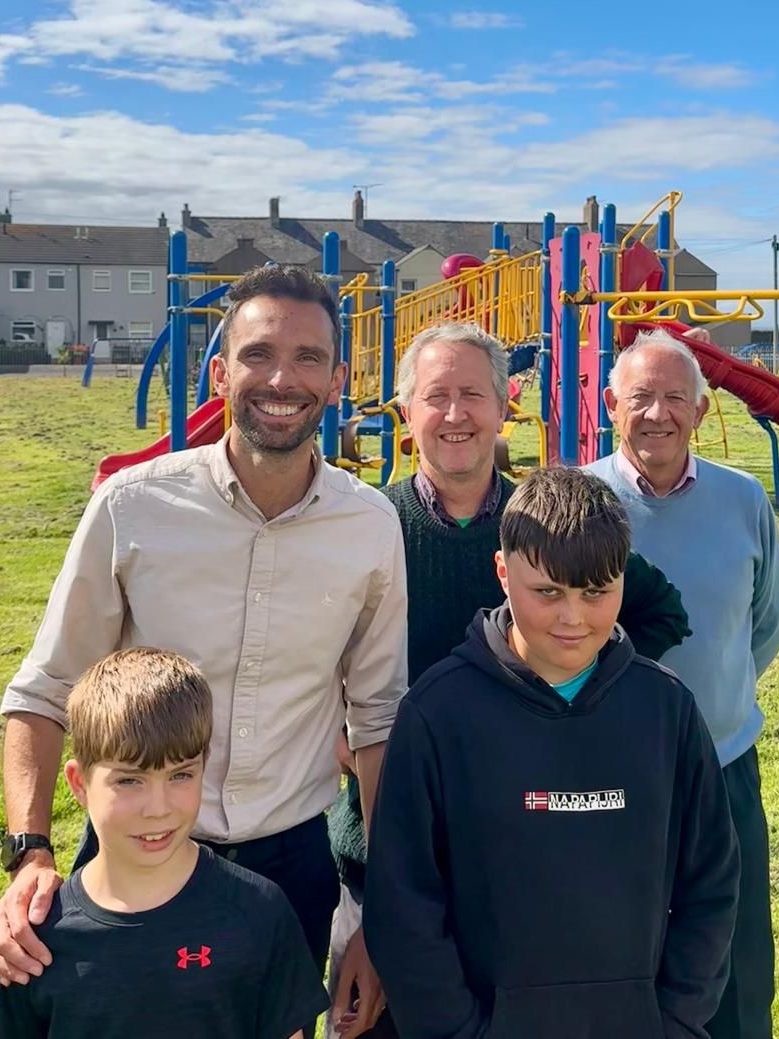
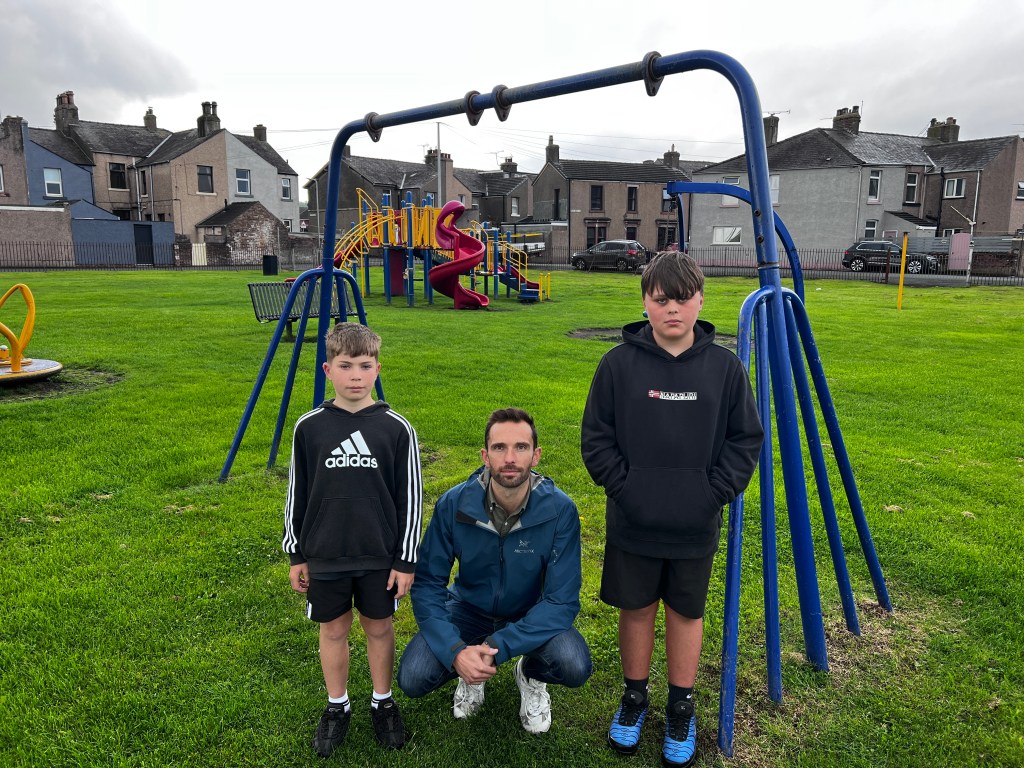
Flimby playground is set for a refresh following a campaign by two young park users with the support of local MP Josh MacAlister.
Kaelan and Ethan, 13, launched a petition which was signed by over 500 Flimby residents calling for improvements to be made to the playground, which is in a poor state of repair, with old and damaged equipment.
Josh took up the cause with Cumberland Council, who have now agreed to undertake some vital maintenance this summer, including replacing the swings, removing graffiti, repainting equipment and removing rust.
Plans for longer term improvements will also be drawn up and Cumberland Council have agreed to make a contribution to a bigger upgrade to the playground. Josh will write to Maryport Town Council and some local businesses about also contributing.
Josh said:
“I want to thank Kaelan and Ethan for their passionate campaign which led to this result.
“Flimby deserves a top notch playground and the repair work this summer is the first step to get us there. I’ll be working to secure the funding needed to deliver it and will ensure that young people who use the park are involved in designing it.”
The Labour Government has announced a radical overhaul of the way local councils are funded, fixing the unfair, outdated system left behind by the Conservatives and allocating money according to need.
Under the Conservatives, rural and coastal areas like ours were overlooked and faced higher costs to deliver essential services across long distances and smaller populations. Coupled with a decade of austerity, councils up and down the country were crippled and left struggling to run basic services.
We’re going to fix this. The local government funding system will be reformed to get councils back on stable footing, improve lives for people across West Cumbria and deliver essential funding for better public services.
Labour will update the decade-old funding system to ensure that councils get the fair share of funding they need to deliver local services, specifically recognising the higher costs of delivering services in coastal, rural and remote communities like ours. For the first time, the Government will factor in things like remoteness and sparsity, seasonal demand from visitors and the cost of public services in coastal economies when assessing funding needs, supporting councils like ours to deliver services more effectively.
Alongside this, the Labour Government has also announced action to make things fairer for council taxpayers by ending outdated rules for tax collection and spreading payments over 12 monthly bills as standard.
At the moment, those facing financial difficulty who miss council tax payments can be required to immediately pay the whole year’s sum, with bailiffs being sent and no payment plan offered. Under Labour’s plans, payment plans will now need to be offered, with councils working closely with those struggling with their bills.
I’ve written to Deputy Prime Minister Angela Rayner, alongside my fellow Cumberland MPs, Cllr Mark Fryer, and Commissioner David Allen, to make the strongest possible case to ensure that Cumberland benefits from this new fair funding review and we’ll be lobbying ministers in the months ahead to ensure we do.
Alongside our work to deliver an ambitious mayoral settlement for Cumbria, our push to make Cumbria the pilot for devolved funding and decision making for farming and nature recovery, our campaign for a major upgrade of the Cumbrian Coast Line, and our effort to bring new nuclear to our area, Cumbria finally has a united team of political leaders working together locally and nationally to speak with one voice and fight for our communities.
With some of the most deprived communities in the country right here in West Cumbria, I’m also arguing for specific, targeted funding from the government to be provided at a local level for long-term investment to help transform deprived neighbourhoods. I’m working closely with ministers to make the case for this programme and hope to have more to say on that soon.
Cumbria’s MPs, council leaders and nuclear industry representatives met with Rail Minister Lord Hendy in Parliament recently to make progress on plans for a major upgrade of the Cumbrian Coast Line through West Cumbria.
After ten years with no progress under the previous government, plans are now motoring ahead. This is the second meeting Cumbrian leaders have held with the Rail Minister and Whitehaven and Workington MP Josh MacAlister has raised the upgrade twice in Parliament with the Secretary of State in the last month.
Responding to Josh’s question in Parliament, Transport Secretary Heidi Alexander said:
“My honourable friend has been a great advocate for his constituents on this topic and makes a strong case for the scheme. My officials are working with Cumberland Council and across Whitehall to refine the business case he refers to.”
Josh said:
“Cumbria is speaking with one voice on this important issue and we are finally making real progress after years of dither and delay under the previous government.
“We have updated the outline business case, we are in the process of sourcing funding to get it to final business case and we are lobbying ministers hard to ensure that once we have that we are in the strongest position we can be to get this project into the government’s infrastructure pipeline during this Parliament.
“The Rail Minister agreed to meet again in the autumn and in the meantime there will be meetings at official level to make progress on developing the next stage of the business case.”
You don’t need me to tell you the state our NHS was in last summer. Record waiting lists, doctors on strike, buildings falling apart, mental health services at the brink of collapse, near impossible to get a GP appointment or find an NHS dentist. We were dangerously close to the NHS ceasing to exist as a publicly funded service, free at the point of use. I was elected as your MP and Labour were put in government on a promise to fix the mess left behind by the Conservatives in our NHS.
We’ve made really good progress nationally and locally to start that work with our first steps over the last 12 months. Nationally, we’ve created 4 million extra appointments against a target of 2 million. Waiting lists are down, we’ve recruited 1,900 more GPs and 6,700 more mental health workers. We’ve pumped money in to create more urgent dental appointments and started reforming the NHS dental contract. And we’ve injected £26 billion extra into the NHS for day to day spending this year, with £29 billion extra coming next year and every year up to 2030. Record investments.
Locally, waiting lists for treatment in north and west Cumbria are down 7%. We’ve got a new Urgent Dental Access Centre based in Whitehaven seeing 140 patients a week. GP practices in Whitehaven and Workington have been given funding to expand their clinical space to create over 4,000 new GP appointments every year and GP numbers are slowly increasing. A new 24/7 community mental health hub will open soon in Whitehaven – one of only six in the country. I’m pleased to have secured a new clinical pathway for cancer patients attending A&E at West Cumberland Hospital. And I’m working to transform primary care in Workington with a new Neighbourhood Health Centre.
This is a great start, but there is much more to do. Last week the government took the next step, laying out a Ten Year Plan to get our NHS back on its feet and make it fit for the future.
The plan lays out an ambitious agenda, ensuring we’re not just spending more money and hoping that will improve things. It aims to give patients more power by delivering three big shifts in how the NHS works: from hospital to community; from analogue to digital; and from sickness to prevention. And it will tackle some of the enduring health inequalities plaguing our country, making sure that those in working class communities like ours are no longer served last.
If we seize the opportunities provided by new technology, medicines, and innovation, then we can deliver better care for all patients – no matter where they live or how much they earn – and better value for taxpayers.
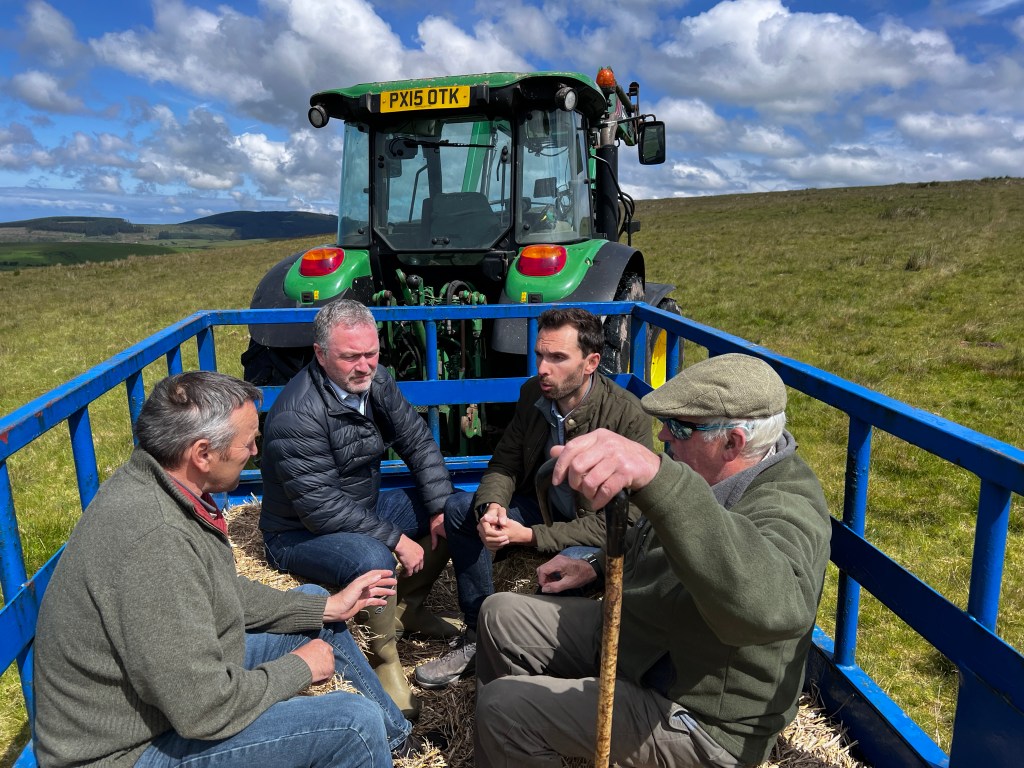
Political, farming, business, education and nature leaders across Cumbria have banded together in a bid to secure a major devolution of funding and decision making for upland communities to support farming and nature recovery in the county.
Over 40 community leaders have backed a bid by Cumbria’s MPs to devolve the government’s budget for farming and nature recovery to the county, meaning funding and decisions about how that money is spent would be made here in Cumbria. At present, schemes are determined by civil servants in Whitehall and farmers and land managers have to submit lengthy and costly bids to national agencies to access funding for farm support and local national recovery projects.
In 2024, farmers in Cumbria received over £100 million through the various government subsidies and schemes. At the Spending Review, the government confirmed the largest ever funding settlement for farming and nature recovery, with £2.7 billion committed each year from 2026 to 2029. Devolving Cumbria’s share of that funding and putting decisions about how it is spent into the hands of local decision makers and upland communities would be a radical shift and the first such experiment in the country.
Leading the bid are Cumbria’s MPs, who want our county to be a test bed for this radical new approach – and say that our area is ready to take on the challenge. In a joint statement, MPs Josh MacAlister, Michelle Scrogham and Markus Campbell-Savours said:
“We’re delighted to be working with local authority leaders, the national park and the leaders of our farming, nature, business and education sectors on this ambitious bid to radically devolve power and funding for the first time out of Whitehall to upland communities to support farming and nature recovery. The support of all of these organisations will be vital to making a success of this.
“We know from our conversations with hundreds of local farmers and land managers that we have the people, knowledge and skills we need right here in Cumbria to make the best decisions about how to spend money to support our unique system of farming and the vital nature recovery work we need to do. We just need the government to back our approach and let us get on with it. We’ll be lobbying ministers hard to secure this pilot for Cumbria.”
Cumbria is home to the largest concentration of Common Land in England and home to 5,000 farms employing 12,000 people. In a letter to Hilary Cottam, who is leading a review for the Department for the Environment, Food and Rural Affairs into farming and life in upland areas, local leaders write that “There is no other upland community in England that offers the scale and variety of farming, nature and conservation opportunities and challenges, as well as existing collaboration and innovation driven by genuine bottom-up momentum.”
Gavin Capstick, Chief Executive of the Lake District National Park Authority, said:
“The Lake District is a truly special place. Its environment, ecology and wildlife and the cultural heritage of its unique upland farming system are all vital parts of our designation as a National Park and as a World Heritage Site. But all these elements face threats and uncertainty. We know we all must go further and faster to improve the state of nature while nurturing and protecting the traditions and value of hill farming communities.
“The Lake District National Park Authority has long championed nature friendly farming as key to meeting many challenges, an attitude which has been embraced by much of the farming community and is demonstrated through many of the Farming in Protected Landscapes (FiPL) projects. However, certainty and support are needed to deliver at scale. We have long argued for bespoke agri-environment options or schemes for the National Park. Schemes that support land managers and farmers to improve the state of nature while recognising the traditions and history that have helped shape the Lake District landscape.
“This proposed pilot is a really exciting opportunity to bring local partners together to co-design schemes that deliver for nature and bring certainty and support to our local farmers.”
Adam Day, Managing Director of The Farmer Network, said:
“The many services and benefits that farming in Cumbria bring to society are often neither recognised nor understood. We forget that we need farmers three times a day. Cumbrian farmers produce great food. They also manage the revered landscapes, contribute hugely to the rural economy and are the bedrock of our rural communities.
“We must ensure a viable and sustainable future for farming in Cumbria. We will need them more than ever in years to come.”
It was the greatest honour of my life to be elected as your MP one year ago.
I promised to be visible and accessible and I’ve hosted 65 advice surgeries, coffee mornings, drop-ins, street surgeries, public meetings, neighbourhood walkabouts and supermarket surgeries, engaging 3,000+ residents in the process. I appreciate everyone who takes the time to talk to me and respect your views, even when we might not always agree on everything. All those conversations help me to learn and shape my thinking as your MP.
I’ve managed to meet more than 300 local organisations. Schools, businesses, housing and healthcare providers, farmers, charities and community groups. These visits and conversations give me invaluable insights that I often then take up directly with ministers to shape policy decisions.
My small and dedicated team and I have dealt with over 6,500 individual pieces of casework from west Cumbrians at the time of writing. About two thirds of these are from people asking me what I think about a policy or issue, will I support or oppose a particular Bill or will I vote for or against a Motion. Politics is to make choices and on every issue I have representations from all sides to weigh up alongside my own views, those set out in Labour’s manifesto and what is in the best interests of the country overall. Many of these are hard choices. I carefully reflect on all the correspondence I receive before making my mind up. I hope people feel my replies reflect this and my choices are considered even when you don’t agree.
The rest of my casework involves representing people where systems have failed and aren’t working as they should. We’ve got hundreds of examples where we’ve managed to help people as a result of our intervention. Sorting out a hospital appointment which keeps getting cancelled. Chasing up delays with housing repairs and getting them done. Securing compensation for someone who had a poor service. Things which make a difference to the daily lives of those affected.
In Parliament, I’ve spoken or asked questions 80 times, with a focus on the priorities raised with me by local people. But this only tells a small part of the story of my work in Parliament. I’ve written dozens of public and private letters to ministers on local issues and had more than 50 ministerial meetings with everyone from the Prime Minister down, all to advocate for West Cumbria. I haven’t tallied up all of my other meetings in Parliament but I’ve had dozens of meetings just to advance the cause of new nuclear in West Cumbria with ministers, advisers, officials and potential vendors and developers.
I hope this reassures people that I am working hard to deliver for you and for West Cumbria every day. If you need my help with anything, please contact me anytime.
We made a manifesto commitment to lower energy bills by £300 during this Parliament. While bills are now far lower than the high point under the Tories (remember when the price cap hit £4,279 in January 2023?) they are still too high and people rightly want to see the change they expected when they cast their votes last year.
The Tories failed to invest in homegrown energy, leaving us exposed to foreign oil and gas and meaning we were one of the worst hit countries by the war in Ukraine. It got worse when Liz Truss crashed the economy and inflation hit double figures.
Fixing the broken energy system they left behind takes time. We’re moving quickly to build up our domestic energy production and changing planning rules to allow us to build even quicker. Billions for offshore wind has been announced, we’ve ended the ban on onshore wind and we’re requiring solar panels on new homes. And let’s not forget the biggest investment in new nuclear in 50 years.
This will give us real energy security and help us stand up to aggressors like Putin, but this new energy generation will take time to end the link between our energy prices and volatile global gas prices. So we’re taking immediate action to bring bills down for as many people as possible.
We listened to the concerns and we’re reinstating the winter fuel payment for all pensioners earning under £35,000 per year. Thousands more pensioners across West Cumbria will now get up to £300 off energy bills this winter; £1,200 saved per pensioner by 2029.
Those in low paid work are also hurting. So we’re nearly doubling the number of households eligible for the Warm Home Discount by extending it to every bill payer getting means tested support. Thousands more families across West Cumbria will get £150 automatically taken off your bills this winter; £600 saved per family by 2029.
We’re investing over £15 billion in home retrofits and upgrades, saving thousands of homes in Cumbria hundreds of pounds. Allocations for each area will be announced shortly and I’m hopeful after months of lobbying ministers that we will get a substantial pot of money for Cumbria.
Finally, because our energy intensive manufacturing businesses are so vital to growth and jobs, we’re taking steps to lower their energy bills aswell. More than 7,000 British businesses will see their bills slashed by up to 25% from 2027.
All of this is a down payment on the longer term lower bills we’ll see for everyone as a result of securing our energy system and protecting it from the rollercoaster of fossil fuel markets, giving working people the security they deserve.
The alternative is going back to the failed Tory policies or, even worse, Reform’s energy plan, which would destroy our domestic energy programme, put nuclear investment at risk and leave us reliant on expensive foreign oil and gas for decades.
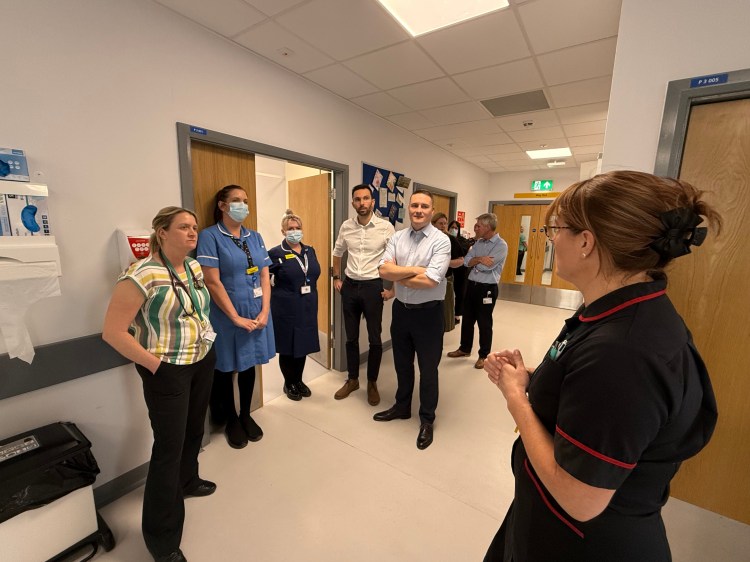
More than 2,700 additional treatments have been carried out on patients in north and west Cumbria over the last year, with the waiting list dropping by 7% overall.
The latest figures from North Cumbria Integrated Care NHS Foundation Trust, which runs West Cumberland Hospital and Cumberland Infirmary, also show that the number of patients waiting more than 12 months for treatment has dropped by a third.
This news comes as national data highlights an additional 3.6 million NHS appointments have been delivered since July 2024, smashing the government’s target to deliver 2 million more appointments in year one.
Whitehaven and Workington MP Josh MacAlister says this is “a clear example of Labour delivering on our promises and the steps being taken to get the NHS working for patients once again”.
£26 billion of additional funding was pumped into the NHS in last year’s Budget to help bring waiting lists down and at last week’s Spending Review the Chancellor committed a further £29 billion for day to day spending on the NHS in every year of this Parliament.
Josh said:
“After the Tories left waiting lists at a record high and patient satisfaction at a record low, hundreds of residents across West Cumbria were stuck left waiting for treatment.
“That’s why falling waiting lists in our area is such good news, as this Labour Government puts the NHS on the road to recovery.
“I know not everyone was happy with all of the choices made at last year’s Budget, but those decisions meant we could invest the money which has led to this drop in waiting lists.
“I’d like to thank our dedicated and hard working NHS staff for their tremendous efforts. Together we can be the generation that takes the NHS from the worst crisis in its history and makes it fit for the future.”
Health and Social Care Secretary, Wes Streeting, said:
“We are putting the NHS on the road to recovery after years of soaring waiting times, by providing record investment and fundamental NHS reform.
“Thanks to our interventions and the hard work of NHS staff, the overall waiting list has now fallen in April for the first time in 17 years – dropping by almost a quarter of a million since we took office.
“This is just the start. We’ve delivered millions of extra appointments since July, we are pushing on with our mission to get the NHS working for patients in West Cumbria once again as we deliver our Plan for Change.”
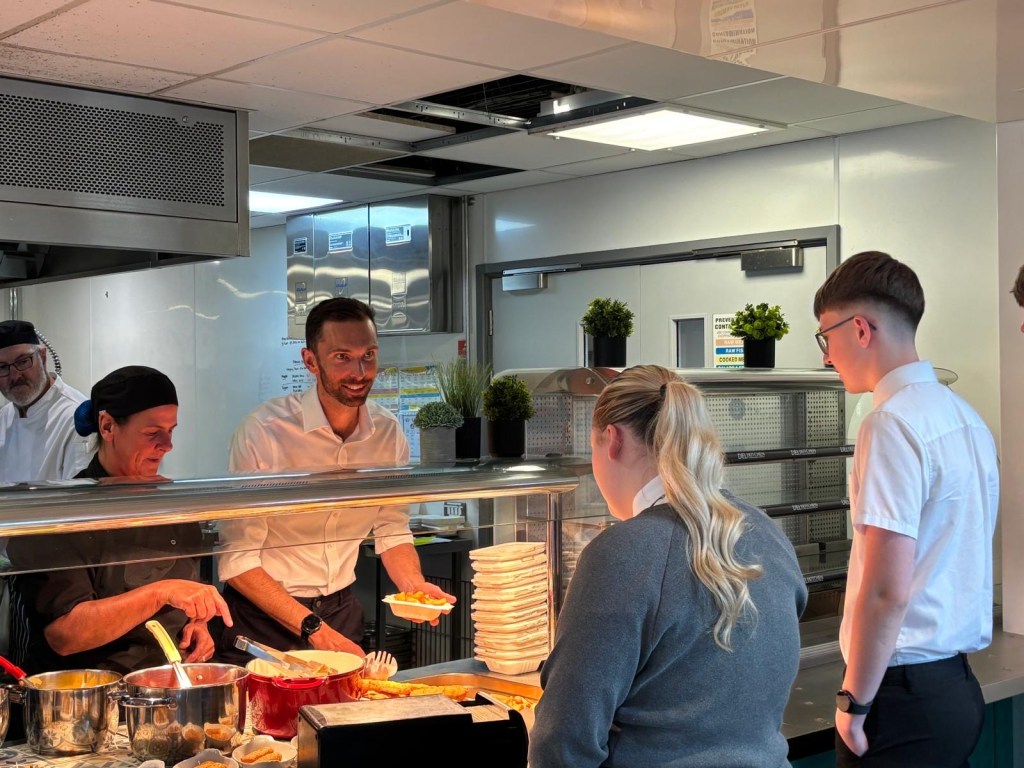
The government has announced that every pupil in West Cumbria whose household is on Universal Credit will have a new entitlement to free school meals.
Starting in September 2026, up to 4,000 more children across West Cumbria will be able to access free school meals, saving parents £500 per year per child and making life easier and more affordable for parents on low incomes who struggle the most.
The government estimates that the expansion of free school meals will lift 100,000 children out of poverty by the end of this Parliament. Giving children access to a nutritious meal during the school day also leads to higher attainment, improved behaviour and better outcomes – meaning they get the best possible education and chance to succeed in work and life.
Since 2018, children have only been eligible for free school meals if their household income is less than £7,400 per year, meaning hundreds of thousands of children living in poverty have been unable to access free school meals.
Labour’s historic new expansion to all those on Universal Credit – many of whom are working families on low wages – will change this and comes ahead of the Child Poverty Taskforce publishing its ten-year-strategy to further drive down child poverty.
Josh said:
“I know from talking to thousands of local parents and visiting dozens of local schools how much the stain of child poverty has impacted families across West Cumbria.
“That’s why I fully support this decisive and much needed action to expand entitlement for free school meals, lifting children across West Cumbria out of poverty and putting money back in parents’ pockets.
“Many of those on Universal Credit are in work but struggling to get by on low wages. That’s why we also introduced a near record cash increase in the minimum wage in April to boost wages. And we’re also expanding access to 30 hours free childcare this autumn to all working parents of children aged 9 months to 4 years old.
“Children across West Cumbria deserve the best start in life, and I’m proud that Labour is delivering this.”
A campaign by two local young people to secure investment in the playground in Flimby has enlisted the help of local MP Josh MacAlister.
The campaign started by Flimby residents Kaelan and Ethan, 13, of Netherhall High School, is calling for play equipment to be cleaned and upgraded and for new equipment to be installed. Kaelan and Ethan went door to door and collected 571 signatures for their petition to improve the playground.
The playground is currently in a very poor state, with swings missing, equipment broken and rusted and lots of graffiti.
Whitehaven and Workington MP Josh MacAlister met with Kaelan and Ethan at the playground to talk about their campaign and hear their ideas for how it could be improved.
Josh said:
“I was really inspired that local young people had taken matters into their own hands and gone door to door right across Flimby to gather support for their campaign and also come up with lots of good ideas for how the playground could be improved.
“I’ve written to the cabinet member and senior officers at Cumberland Council to ask for the prioritisation of funding to make improvements to the park and for the council to work with Kaelan and Ethan so their ideas can be incorporated into any improvement plan.
“The project has my full support and I hope we’re able to secure investment soon.”



 Josh MacAlister MP