
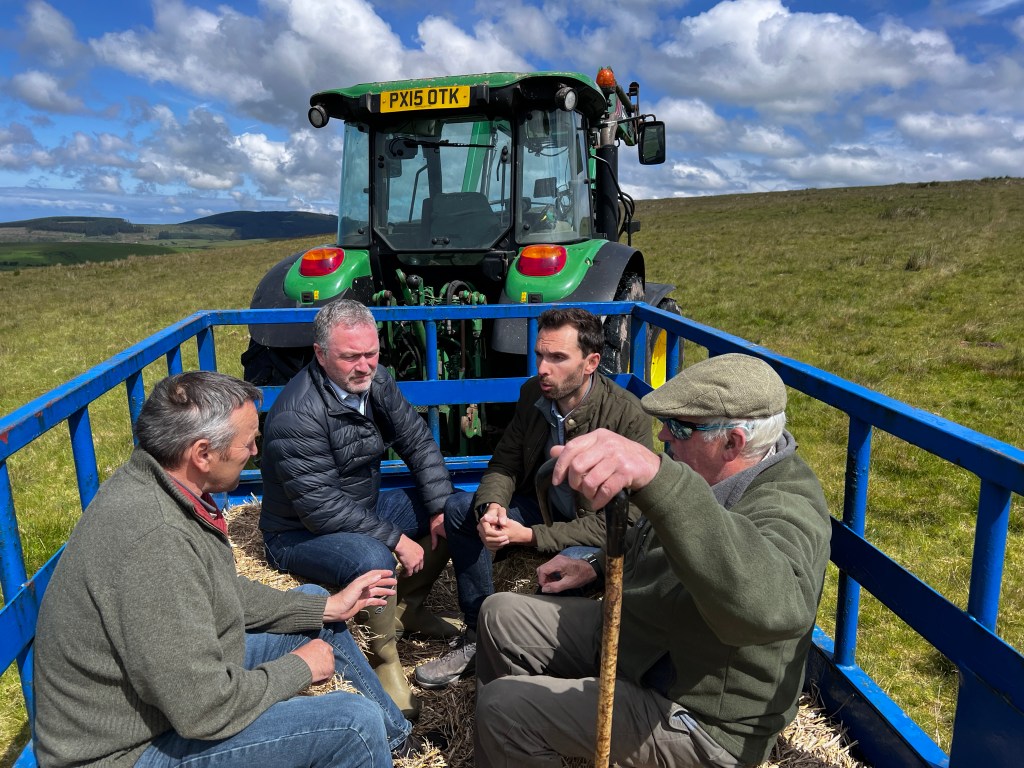
Political, farming, business, education and nature leaders across Cumbria have banded together in a bid to secure a major devolution of funding and decision making for upland communities to support farming and nature recovery in the county.
Over 40 community leaders have backed a bid by Cumbria’s MPs to devolve the government’s budget for farming and nature recovery to the county, meaning funding and decisions about how that money is spent would be made here in Cumbria. At present, schemes are determined by civil servants in Whitehall and farmers and land managers have to submit lengthy and costly bids to national agencies to access funding for farm support and local national recovery projects.
In 2024, farmers in Cumbria received over £100 million through the various government subsidies and schemes. At the Spending Review, the government confirmed the largest ever funding settlement for farming and nature recovery, with £2.7 billion committed each year from 2026 to 2029. Devolving Cumbria’s share of that funding and putting decisions about how it is spent into the hands of local decision makers and upland communities would be a radical shift and the first such experiment in the country.
Leading the bid are Cumbria’s MPs, who want our county to be a test bed for this radical new approach – and say that our area is ready to take on the challenge. In a joint statement, MPs Josh MacAlister, Michelle Scrogham and Markus Campbell-Savours said:
“We’re delighted to be working with local authority leaders, the national park and the leaders of our farming, nature, business and education sectors on this ambitious bid to radically devolve power and funding for the first time out of Whitehall to upland communities to support farming and nature recovery. The support of all of these organisations will be vital to making a success of this.
“We know from our conversations with hundreds of local farmers and land managers that we have the people, knowledge and skills we need right here in Cumbria to make the best decisions about how to spend money to support our unique system of farming and the vital nature recovery work we need to do. We just need the government to back our approach and let us get on with it. We’ll be lobbying ministers hard to secure this pilot for Cumbria.”
Cumbria is home to the largest concentration of Common Land in England and home to 5,000 farms employing 12,000 people. In a letter to Hilary Cottam, who is leading a review for the Department for the Environment, Food and Rural Affairs into farming and life in upland areas, local leaders write that “There is no other upland community in England that offers the scale and variety of farming, nature and conservation opportunities and challenges, as well as existing collaboration and innovation driven by genuine bottom-up momentum.”
Gavin Capstick, Chief Executive of the Lake District National Park Authority, said:
“The Lake District is a truly special place. Its environment, ecology and wildlife and the cultural heritage of its unique upland farming system are all vital parts of our designation as a National Park and as a World Heritage Site. But all these elements face threats and uncertainty. We know we all must go further and faster to improve the state of nature while nurturing and protecting the traditions and value of hill farming communities.
“The Lake District National Park Authority has long championed nature friendly farming as key to meeting many challenges, an attitude which has been embraced by much of the farming community and is demonstrated through many of the Farming in Protected Landscapes (FiPL) projects. However, certainty and support are needed to deliver at scale. We have long argued for bespoke agri-environment options or schemes for the National Park. Schemes that support land managers and farmers to improve the state of nature while recognising the traditions and history that have helped shape the Lake District landscape.
“This proposed pilot is a really exciting opportunity to bring local partners together to co-design schemes that deliver for nature and bring certainty and support to our local farmers.”
Adam Day, Managing Director of The Farmer Network, said:
“The many services and benefits that farming in Cumbria bring to society are often neither recognised nor understood. We forget that we need farmers three times a day. Cumbrian farmers produce great food. They also manage the revered landscapes, contribute hugely to the rural economy and are the bedrock of our rural communities.
“We must ensure a viable and sustainable future for farming in Cumbria. We will need them more than ever in years to come.”
 Josh MacAlister MP