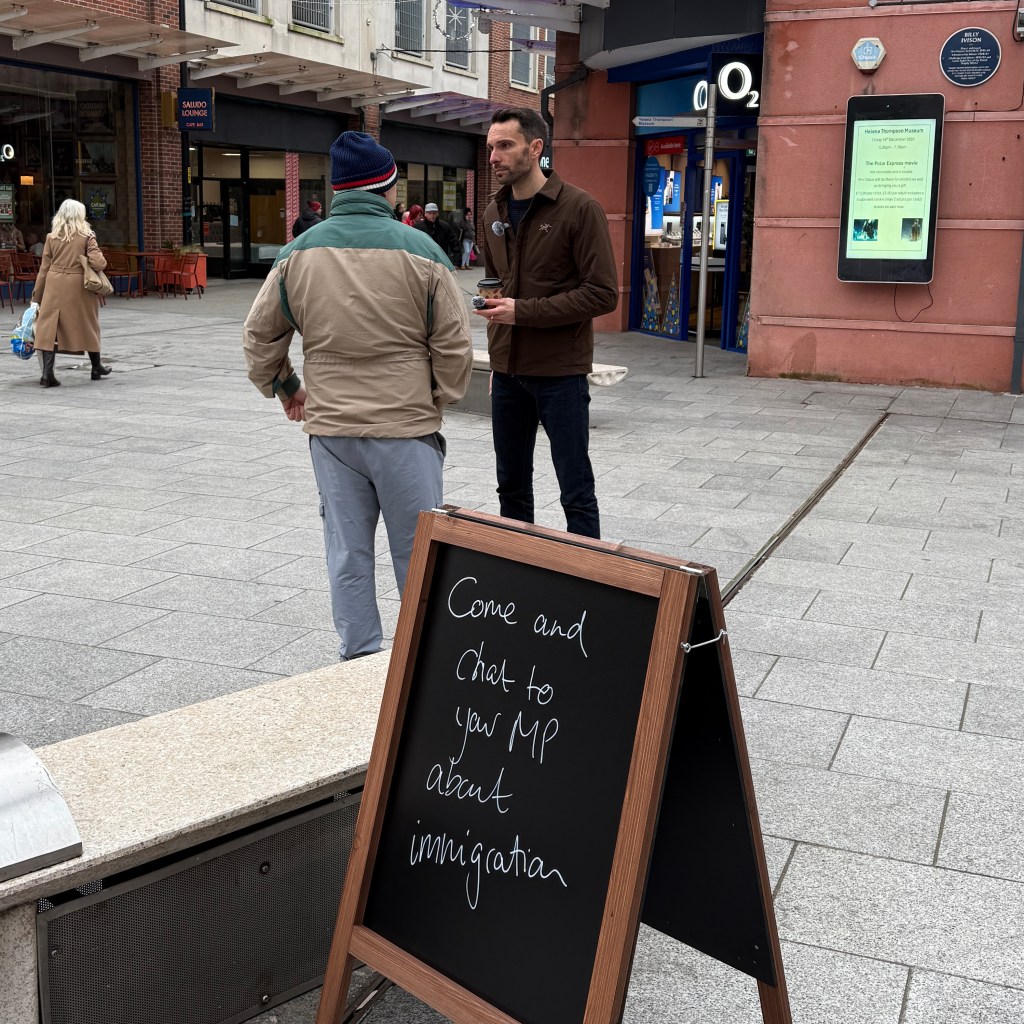
Shortly before Christmas, I took to the streets of Workington town centre and invited west Cumbrians to come and talk to me about immigration. It’s a subject some politicians avoid like the plague, but I don’t want to duck the big issues. I can only represent your interests in Parliament if I’m listening carefully to what you think and what you want me – and the government – to do.
The message came through loud and clear: you want illegal immigration stopped and our borders controlled. People aren’t opposed to legal migrants who contribute to our NHS, our care homes and our communities – quite the opposite. You know that without those workers, public services in West Cumbria would struggle. I also heard real sympathy for genuine refugees who arrive through safe and legal routes. But you are rightly fed up with a broken system that has allowed criminals to exploit vulnerable people, undermine law and order, and leave taxpayers footing the bill for those who have no right to be here.
So let me spell out what this government is doing – and why I think you’ll welcome it. We are going after people-smuggling gangs, accelerating the return of those with no right to stay, and fixing the chaotic asylum system we inherited.
You may not have seen it splashed across the front pages, but just last week Adem Savas was sentenced to 11 years in prison and fined £346,000 for his role as the single most significant supplier of boats and equipment to Channel-crossing gangs over the past five years. His kit was used in half of all crossings in 2023 alone. This conviction followed a joint UK-Belgian operation launched by this government to smash the gangs – exactly as we promised at the election.
And that’s not all. Our Border Security, Asylum and Immigration Act, which became law in December, has given law enforcement unprecedented powers: accessing smugglers’ phone data, creating new offences for supplying boats and engines, and criminalising the online promotion of illegal crossings. One of those new offences – endangering life at sea – was used for the first time earlier this month to arrest an 18-year-old who piloted a boat carrying 46 people across the Channel.
We’ve secured a deal with France that has returned just shy of 200 people who crossed illegally and we will be ramping this up . We’ve worked with Germany to pass new laws that could jail smugglers storing boats there for up to ten years. We’ve led the world with the first sanctions targeting more than two dozen key figures in smuggling networks. Hundreds of people working illegally – including nine here in West Cumbria – have been arrested. We’re expanding “deport now, appeal later” for foreign national offenders. And since the election, 50,000 people have been returned.
These are real examples of real action.
To those in West Cumbria who want illegal immigration stopped: I hear you, I agree with you, and this government is delivering. It’s time to restore control, uphold humanity, and make the system work – for communities and for those truly in need.
Cumbria is set to be included in a new national Uplands Transformation project following months of joint work by Josh MacAlister MP and the county’s other Labour MPs with ministers and leading experts, alongside a wider package of measures to support farmers and rural communities.
The project, following work led by social entrepreneur Dr Hilary Cottam for the Department for the Environment, Food & Rural Affairs, will trial a new network-based approach to supporting upland communities. After initial work on Dartmoor, it will expand into Cumbria later this year, recognising the unique challenges facing upland farming and the rural communities that depend on it.
The announcement follows sustained engagement by Cumbria’s Labour MPs – Josh MacAlister, Julie Minns, and Michelle Scrogham – working with ministers to ensure Cumbria’s voice is heard and the county is included as the programme develops.
The Uplands Transformation project builds on feedback from farmers and upland communities over the past year. Dr Cottam was hosted by MPs in Cumbria last summer and met with farmers, agriculture businesses and nature and environmental charities to discuss the potential of Cumbria’s inclusion in the project. Over the next two years, it will focus on delivering practical, system-wide, change that will be led by local people who understand best how to solve the problems they are facing. The project will provide support to grassroots initiatives creating stronger farming clusters, exploring new mutual funding models, and laying the foundations for additional income streams, from nature-based enterprises to regenerative tourism and circular economy initiatives.
Alongside the uplands work, the government has announced a wider package of measures for farmers, including:
Reforms to the Sustainable Farming Incentive (SFI) to cut complexity and prioritise smaller farms
A three-year extension to the Farming in Protected Landscapes programme, with £30 million next year alone
A new £30 million investment to support farmer-led advice, collaboration and peer-to-peer learning
Josh MacAlister MP said:
“Farming in Cumbria is different – tougher land, harsher conditions, longer distances and communities that depend on farming not just for food, but for the fabric of rural life. For too long, national schemes haven’t reflected that reality.
“That’s why I’ve been working closely, alongside my Cumbrian Labour colleagues, with ministers and Dr Hilary Cottam to make sure Cumbria is included in this uplands work. This is about listening to farmers, backing local networks, and building practical solutions that work on the ground – not imposing one-size-fits-all answers from Whitehall.
“These announcements are a step towards giving farmers more certainty, less bureaucracy, and support that recognises the vital role they play in our landscapes, our food system and our rural economy.”
Further details on the Sustainable Farming Incentive will be published ahead of the next application window which opens in June, and work on the Uplands Transformation project will continue to develop with local MPs and communities fully involved.
Local farmers are invited to attend Josh’s next Farmers’ Forum at 6pm on Friday 30th January in Whitehaven to find out more. Register at joshmacalister.uk/meetjosh
New analysis from Josh MacAlister MP reveals local rail users are set for a cost of living boost thanks to the first freeze on rail fares in 30 years.
There are over 1 million journeys that either start or end at stations in West Cumbria each year – an estimated 45% are regulated and therefore subject to Labour’s fare freeze. With the average journey costing £6.88, a usual rise by July’s inflation figure would have seen each fare increase by 33p, meaning a total hike across those stations of £162,000 – a figure that local passengers will now save this year thanks to Labour.
Publishing the figures, Josh said:
“We are determined to help west Cumbrian families with the cost of living. Inflation is falling, wages are rising – including a huge rise in the minimum wage – and help is on the way with energy bills, more free breakfast clubs and an expansion of free school meals. Now rail fares are frozen for the first time in a generation, putting real money back in passengers’ pockets and circulating around the local economy.”
Residents with a passion for community leadership are being encouraged to apply for a new voluntary role that will help shape the future of south Whitehaven.
Applications are now open for an Independent Chair of the Pride in Place Neighbourhood Board, which will oversee a £20 million, 10-year investment in Mirehouse, Kells, Woodhouse, Greenbank and Sandwith. The programme aims to put local people at the heart of decision-making, supporting long-term regeneration and neighbourhood pride.
The Chair will lead a newly established Neighbourhood Board, bringing together residents, community organisations, businesses and public partners to co-create a long-term Pride in Place Plan for the area. The role is part-time and flexible, requiring around 8–10 hours per month, with reasonable expenses reimbursed.
The successful candidate will be a respected local leader with strong communication skills and a commitment to inclusive, resident-led decision-making. While experience in governance or community leadership is desirable, enthusiasm, integrity and a strong connection to the area are essential.
Josh MacAlister MP, who helped to secure the Pride in Place investment and will sit on the Board, said:
“This is a once-in-a-generation opportunity for south Whitehaven. Pride in Place is about trusting local people to shape the future of their neighbourhoods, and the Chair will play a vital role in making that vision a reality. I’d strongly encourage anyone with the passion and commitment to lead inclusively to consider applying.”
Cllr Emma Williamson added:
“Strong, independent leadership is crucial to ensuring this investment delivers lasting benefits for local residents. The Chair will help bring people together, amplify local voices and ensure decisions are made transparently and fairly. We’re looking for someone who truly believes in community power and collaboration.”
The post is offered on a fixed-term basis until 2030, with the potential to extend, and provides a unique opportunity to influence how significant public investment is delivered at neighbourhood level.
Applicants are asked to submit a CV and supporting statement (up to 1,000 words) outlining their connection to the area, relevant experience and vision for inclusive community leadership to communitydevelopment@cumberland.gov.uk.
The closing date for applications is 30th January, with interviews scheduled for February.
Further information about the role is available below and Josh and Emma are happy to have an informal discussion with anyone interested in applying.
In the final week of the year, it feels right to pause and take stock of 2025. Not in a rose-tinted way, and not by talking down the very real challenges many people in West Cumbria are still facing, but honestly and with a sense of where we go next.
This has not been an easy year for everyone. After years of chaos and uncertainty, too many families are still feeling the pressure of high bills, stretched public services and the simple worry of whether things will ever get better.
There is anger at the whole political establishment – the Tories for getting us here and my party for a sense that we could have done more in our first 18 months to deliver the change we promised. I hear it and I apologise on behalf of the government to anyone who feels let down.
Populists on the far left and far right feed off this anger. They come bearing easy answers to complex problems and I understand the temptation to want to blow up the whole system and follow them down the rabbit hole. But progress is starting to show.
After a long period when politics felt noisy but ineffective, 2025 has been about getting back to basics: rebuilding trust, making government work again, and focusing on practical change. There have been missteps along the way – and there is a lot more to do – but I firmly believe the country and specifically West Cumbria is in a better place now than it was at the start of the year thanks to the action we’re taking.
There have been some positive developments in the economy. Six interest rate cuts, inflation coming down, some signs of growth and stability in the markets. Those may seem abstract but I saw someone post the other day about a 2% cut to their mortgage rate, which means a 20% drop in their monthly mortgage payments. Think where we were under Liz Truss and compare it to where we are now.
We’ve also seen meaningful measures to ease the cost of living pressures faced by workers, families and older people. Above inflation increases to Universal Credit (most recipients are in work), a big boost to the minimum wage, the welcome reversal of the decision on winter fuel allowance, an expansion of the Warm Home Discount to give thousands more west Cumbrians £150 off energy bills this winter and the rollout of universal free childcare and the first wave of free school breakfast clubs. Freezes to fuel duty, rail and bus fares and prescription charges will also help a little.
Locally, I’m most proud of the progress to unlock new nuclear power at Pioneer Park. We started the year with no agreement on use of the land at Moorside, no plan and no clear way forward. We end it with roadblocks removed, backing from the very top of government, serious interest from credible nuclear developers and a £1 million masterplan under development. By this time next year I hope we’ll either have a developer selected or be very close to doing so.
Nationally, the focus this year has been on stability and long-term decisions. That doesn’t grab headlines in the same way as drama, but it’s what communities like ours need. Stability is what allows businesses to plan, councils to deliver, and families to feel more secure about the future.
I’m pleased this means we’ve been able to deliver the first multi-year funding settlements for our nuclear sector, NHS and local authority in more than a decade – our biggest local employers and some of our most important public services. This funding certainty – which includes an average annual increase of government funding for nuclear decommissioning of £600 million, record sums for our NHS and a 14% increase in core spending power for Cumberland Council – means job certainty for many and the ability to plan long-term investment.
We’ve already seen some of that this year in the NHS – a new Urgent Dental Access Centre, our new 24/7 community mental health hub (finally opening in January), investment in local GP practices and, just announced, a new £4 million Gynaecology Department at West Cumberland Hospital.
Big boosts to specific council funding streams will also deliver visible improvements next year. Nearly £100 million for local roads, an extra £18 million to support bus services and £4.5 million for walking and cycle routes means making it easier to get around. £5 million I’ve provided as Children’s Minister will improve family support, early intervention and child protection services. And we’re putting more money into specialist school provision for children with special educational needs and disabilities meaning more supported places for local children.
There are also quieter signs of progress that don’t always make the front page: more constructive relationships between local partners, fewer short-term fixes and more long-term thinking, and a renewed sense that problems are being tackled rather than passed on. That’s something I’ve been working hard on at a local level. For example, bringing together local authority and nuclear partners to think differently about how we best use nuclear social impact funding to tackle long-term challenges in our local economy – something I hope we’ll be able to announce a breakthrough on very soon.
That doesn’t mean everything is fixed. It isn’t. There are still waiting lists that are too long, costs that are too high, and communities that feel overlooked. Acknowledging that isn’t pessimism – it’s the starting point for doing better. But we’ll see further action to bring down waiting lists in the new year, a further boost to the minimum wage, and every household will get £150 off energy bills from April. And we’ll start to see investment coming into some of our most overlooked communities through the Pride in Place programme, including south Whitehaven, Maryport and Flimby. We’ll shortly see publication of the masterplan for Whitehaven town centre for consultation. Progress with town deals in Workington and Cleator Moor is gaining pace. And new funding for Egremont will help to revive the town centre.
As we head into a new year, my priority is simple: to keep pushing for steady, practical improvements that make a real difference to everyday life in West Cumbria. Not quick wins for the sake of it, but progress you can actually feel. In industry, infrastructure and public services.
Thank you to everyone who has taken the time to share their experiences with me this year. My office has dealt with more than 10,000 cases. Those conversations matter, and they shape the work ahead. 2026 won’t be perfect either – no year ever is – but if we keep moving in the right direction, together, then we can build the brighter future we need and deserve in West Cumbria.
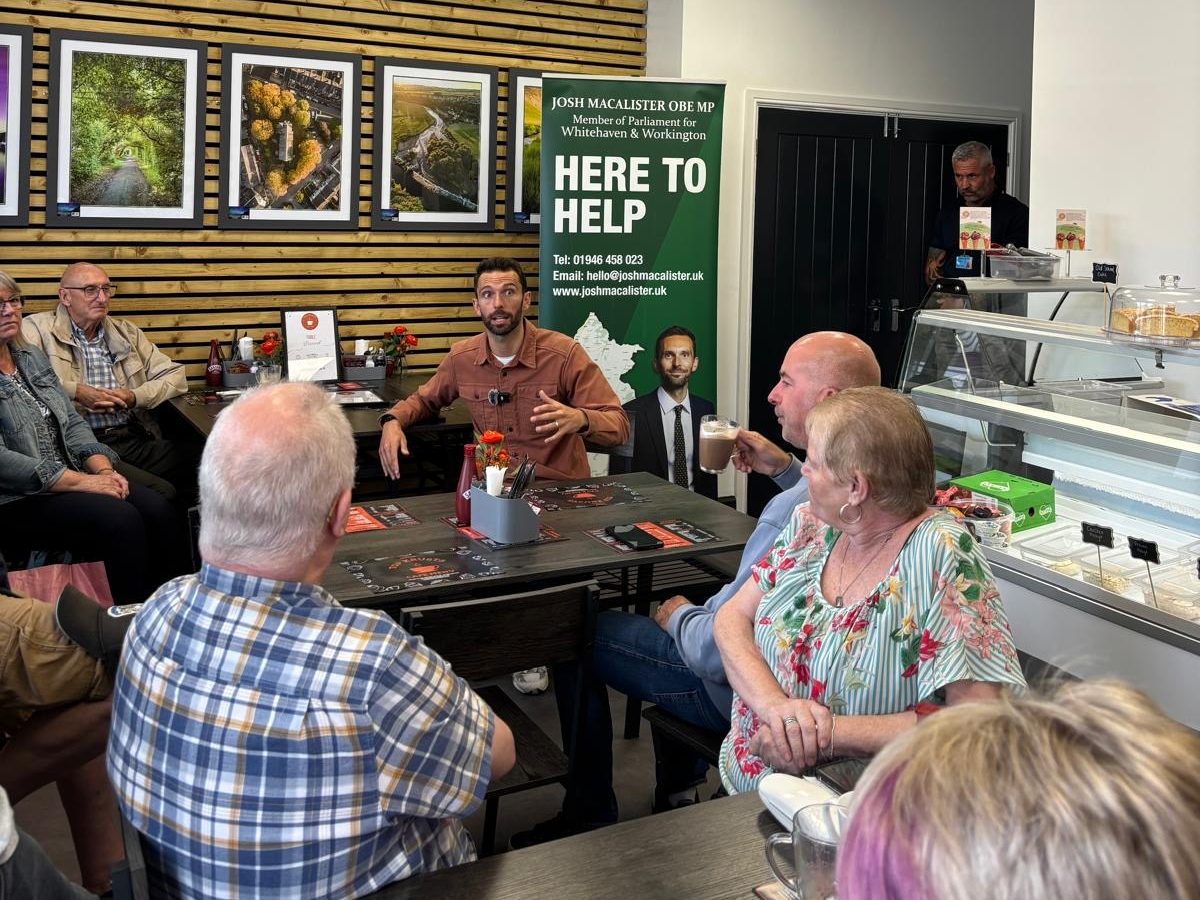
Josh MacAlister MP has this week marked a major milestone since being elected in July 2024, having now held 100 public events across West Cumbria, with more than 3,000 local people taking part.
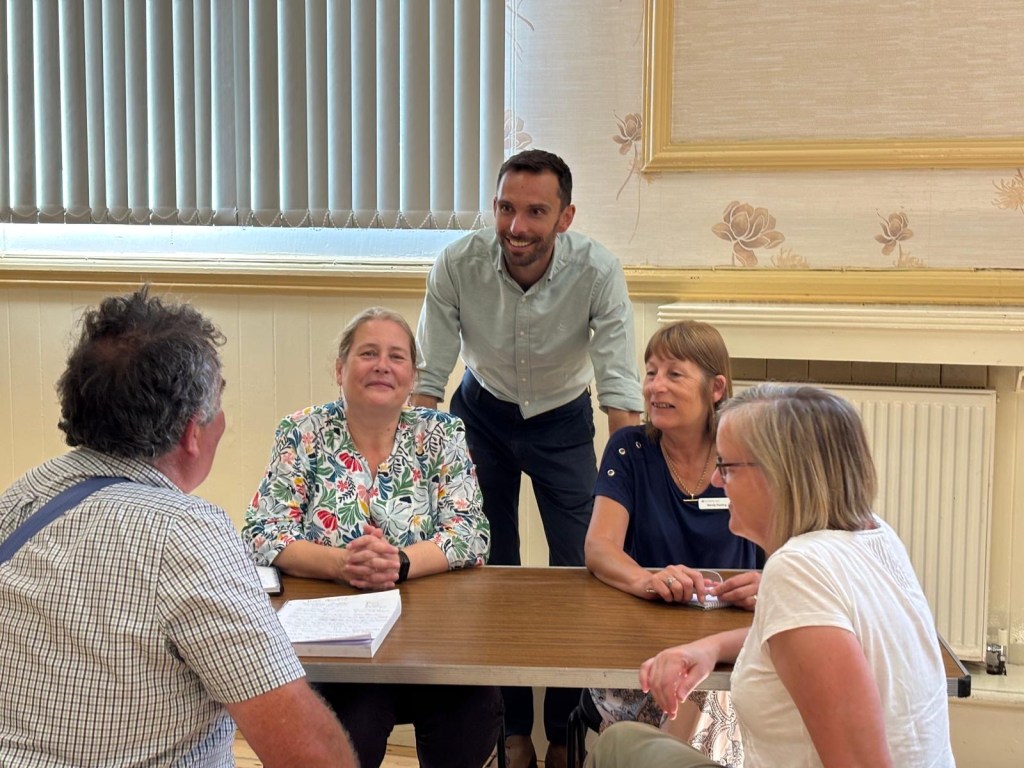
From public meetings to coffee mornings, drop-ins to street surgeries, Josh has held events in every corner of West Cumbria. The events have been about one simple principle: being present, listening carefully, and acting on what matters to local people.
Josh said:
“I made a clear commitment to be an MP who is visible, accessible and rooted in our community. Reaching 100 public events is not about ticking boxes – it’s about listening to people’s experiences and making sure West Cumbria’s voice is heard loud and clear in Parliament.
“I’m hugely grateful to the more than 3,000 people who came along or stopped to chat, asked tough questions, shared ideas or simply said hello. This is how we rebuild trust in politics – by showing up and doing the work.”
This programme of public events is in addition to more than 300 meetings and visits with local schools, businesses, charities, community groups and others.
Josh has announced a new programme of 18 public events taking place between January and March 2026, giving even more residents the chance to meet their MP, raise issues and help shape local priorities.
The programme will include:
Open public meetings
Community drop-ins
Supermarket and street surgeries
Coffee mornings
Events will be spread across towns and villages across West Cumbria to ensure as many people as possible can attend.
Josh added:
“Politics works best when it’s a conversation, not a broadcast. I want to hear from people who agree with me, people who disagree with me, and people who’ve never been to a political event before.
“If you live in West Cumbria, these events are for you. Come along, bring your questions, and help shape the future of our area.”
Full details of dates, locations and how to register can be found at joshmacalister.uk/meetjosh, or by calling 01946 458023.
This Christmas, I want to take a moment to reflect on what makes West Cumbria such a special place to live. This time of year encourages us to slow down, look around, and recognise the strength we draw from each other – something the people of our area understand better than most.
West Cumbria has never been defined by easy times. Our history is one of hard work, industrial pride and communities that pull together when challenges arise. Whether it’s economic uncertainty, pressures on public services, or the rising cost of living, people here have faced difficulties with quiet determination and a strong sense of fairness. That resilience is not something you can legislate for – it comes from shared values, neighbourliness, and a deep-rooted belief that no one should face hardship alone.
At Christmas especially, those values shine through. Across our towns and villages, people are looking out for one another – checking in on elderly neighbours, volunteering their time, donating what they can, and making sure that kindness reaches those who need it most. It’s this everyday compassion that sustains our communities, often unnoticed but always invaluable.
I’ve been privileged this Christmas to meet just a few of those people. Rev. Sharon Murphy at St. Mary’s Church in Westfield, who has turned her church into a hub for the community. Eric Gillespie from Cleator Moor, whose door is open to anyone who needs it for food and a hot cuppa. Jules Huck who runs Hearts of Gold West Cumbria, collecting donations to make sure struggling local families have presents to open on Christmas Day. And the volunteers from Salterbeck Tenants & Residents Association and Workington Derwent Rotary Club who run the Food Pantry at the Oval Centre. These and many more show the heart of West Cumbria.
As we celebrate the festive season, we should also be honest about the challenges ahead. Too many families are feeling the strain, and too many people are worried about what the new year might bring. But if there’s one thing West Cumbria has shown time and again, it’s that we face the future strongest when we do so together. By listening to one another, supporting local businesses, and investing in our communities, we can build the confidence and security people deserve.
Christmas is a time for gratitude – for the NHS staff working through the holidays, for emergency services keeping us safe, for carers, volunteers, and all those whose work doesn’t stop just because the calendar says so. It’s also a time to appreciate the simple things: family, friendship, and the comfort of knowing you belong to a community that cares.
I hope this Christmas brings moments of warmth and rest for you and your loved ones. Thank you for everything you do, not just at this time of year, but all year round, to make West Cumbria the resilient, compassionate place it is. I wish you a peaceful Christmas and a hopeful New Year.
Today the government announced really welcome changes to Agricultural and Business Property Relief. I know how strongly many farmers and rural communities across West Cumbria feel about this issue.
From the outset, I have been clear that family farms must be protected. Policy only works when it reflects the real, lived experience of the people it affects. That is why, over recent months, I have spent a great deal of time listening to farmers locally and feeding those views back into government. I have not held back!
Alongside other Labour MPs representing rural and farming communities, I have been involved in extensive behind-the-scenes work with ministers in both the Treasury and Defra. That has meant many detailed conversations – sometimes challenging, always constructive – about how inheritance tax changes would land on family farms like those here in West Cumbria.
Those conversations have made a difference.
The government has listened and has now confirmed a significant increase in the Agricultural and Business Property Relief threshold, alongside the introduction of spousal transfer.
Under the changes announced today, the inheritance tax threshold for Agricultural and Business Property Relief will rise from £1 million to £2.5 million when the reforms come into force in April 2026. Crucially, this allowance can now be transferred between spouses or civil partners, meaning a farming couple will be able to pass on up to £5 million of qualifying farm and business assets before any inheritance tax is paid, on top of existing personal allowances. As a result, the number of farms affected by inheritance tax will be cut by around half, with the vast majority of family farms paying no additional tax at all. For those larger farms that are affected, bills will be significantly reduced, ensuring the reforms focus only on the very largest estates while better protecting working family farms.
The National Farmers’ Union has been clear about the importance of this shift, saying:
“I am thankful common sense has prevailed, and the government has listened… These conversations have led to today’s changes, which were so desperately needed. From the start, the government said it was trying to protect the family farm, and the change announced today brings this much closer to reality for many.”
That reflects exactly what farmers here have been telling me – and what I and colleagues have been consistently raising with ministers.
I support the principle that the very largest estates should pay their fair share, but I have also been clear that the threshold originally proposed was too low and risked unintended consequences for working family farms. Increasing the allowance and allowing spouses to transfer it between them is the right move, and one that has only been possible because of sustained engagement between farmers, the NFU, and Labour MPs pressing the case from rural Britain.
I want to thank everyone who has taken the time to share their experiences and concerns with me. This change shows that when government listens – and when local voices are taken seriously – policy can be improved.
I will continue to work with colleagues in Westminster to make sure farming has a strong voice at the heart of government, and that policies affecting rural communities are shaped with you, not done to you. I hope to have more to say on my efforts to devolve support for farming and nature recovery to Cumbria in January.
Don’t forget that my next Farmers’ Forum takes place on 30th January at 6pm. Register at joshmacalister.uk/meetjosh
Care leavers across Cumbria will benefit from free prescriptions, dental and eyecare services up to the age of 25 following a package of reforms developed by Josh MacAlister MP as part of work he carried out for the Secretary of State for Health.
The measures, announced today by the Department of Health and Social Care, are the direct result of work led by Josh MacAlister earlier this year when he was asked by the Health Secretary to advise on how the NHS and wider health system could better meet its responsibilities to children in care and care leavers.
The changes will make a practical difference for young people leaving care across Cumbria – helping to address long-standing health inequalities and remove barriers as they move into adulthood.
By the end of 2026, care leavers will receive free prescriptions, dental care and eyecare through the NHS Low Income Scheme, removing a major financial barrier faced by many young people when they leave care.
The package also includes new pilots to improve mental health support for children in care and care leavers by pooling budgets between local authorities and NHS Integrated Care Boards. This will support closer joint working between councils, NHS services and community providers so children can get help earlier, rather than being passed between services or waiting until they reach crisis point.
As part of the reforms, the NHS will also strengthen its role as an employer for care-experienced people. From 2026-27, a bespoke paid supported internship pilot will be launched for care leavers who are furthest from the labour market. In addition, people of any age who have been in care will be eligible for the NHS guaranteed interview scheme if they meet the minimum criteria.
Josh MacAlister MP, Minister for Children and Families and MP for Whitehaven and Workington, said:
“The disadvantage faced by children who’ve grown up in care is a huge social injustice. That’s why we’re taking cross-government action to transform life chances for these children and care leavers.
“This package of health measures will make a tangible difference to reduce health inequalities, keep more children safe and help more families with intensive support.
“It also delivers on recommendations from the Independent Review of Children’s Social Care that I published in 2022. This government is delivering meaningful change to break down barriers to opportunity, especially for those in care.”
Health and Social Care Secretary Wes Streeting said:
“Those in care face the toughest start in life and as a result suffer from a barrage of health inequalities, hampering their chances of going on to lead a happy, successful and fulfilling life.
“I’m proud that this government and the work Josh did in my department will help break down those barriers as part of our mission to give every child the best start in life.
“Giving children in care and care leavers improved healthcare and career opportunities in the NHS is a step towards this goal as we raise the healthiest generation of children ever.”
The package also strengthens safeguarding, improving how information is shared between health services, social care, schools and the police. GPs will be alerted when a child is in care or subject to a child protection plan, ensuring professionals across Cumbria have the full picture and can act quickly to keep children safe.
The measures deliver on recommendations from the Independent Review of Children’s Social Care and sit alongside wider reforms in the Children’s Wellbeing and Schools Bill, increased investment in family help services and expanded support for young people into education, training and employment.
Together, the changes represent a clear step towards a more responsible, joined-up system for care-experienced children and young people in Cumbria – ensuring their health, safety and future opportunities are not determined by the circumstances of their early lives.
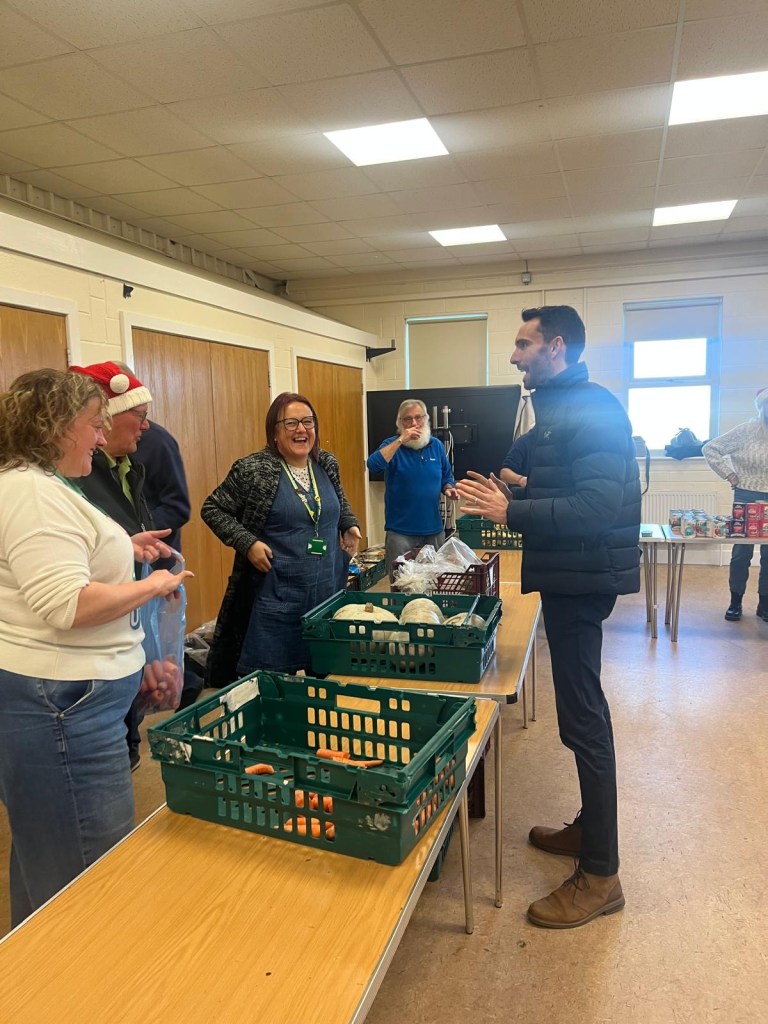
Josh MacAlister MP has visited The Oval Centre in Salterbeck to thank volunteers who are helping support local families and reduce waste in the community.
During the visit, Josh met volunteers from Salterbeck Tenants and Residents Association (STAR) and Workington Derwent Rotary Club, who run the monthly Food Pantry at the Oval. The Pantry helps local people access affordable food and everyday essentials, while also offering a friendly place for people to meet and support each other.
Josh spent time chatting with volunteers and hearing first-hand about the difference the Pantry is making for local residents, particularly with ongoing cost-of-living pressures.
He also visited the new Refill Shop, run by Patch at the RePaint Centre, which has recently opened at the Oval. The shop allows people to refill their household cleaning products instead of buying new plastic bottles, helping families save money while cutting down on plastic waste.
Speaking after the visit, Josh said it was inspiring to see so much community spirit in action.
“The Oval Centre is full of people giving their time to help others,” he said. “The Food Pantry and the new Refill Shop are practical ideas that really work – they save people money, bring neighbours together and help look after the environment at the same time.”
Volunteers from STAR, Workington Derwent Rotary Club and the RePaint Centre said they were pleased to show the MP how the projects work and to highlight the role local volunteers play in keeping them going.
The Food Pantry runs from 11am on the third Friday of every month at The Oval Centre, with a cuppa and a cake available from 10am. No referral is necessary.










 Josh MacAlister MP